CRA vulnerability management for machine and plant builders — from SBOM creation to supplier monitoring.

    Monitor vulnerabilities in your own software and in supplier components centrally, assess them per installation, document them and report within the 24-hour deadline.
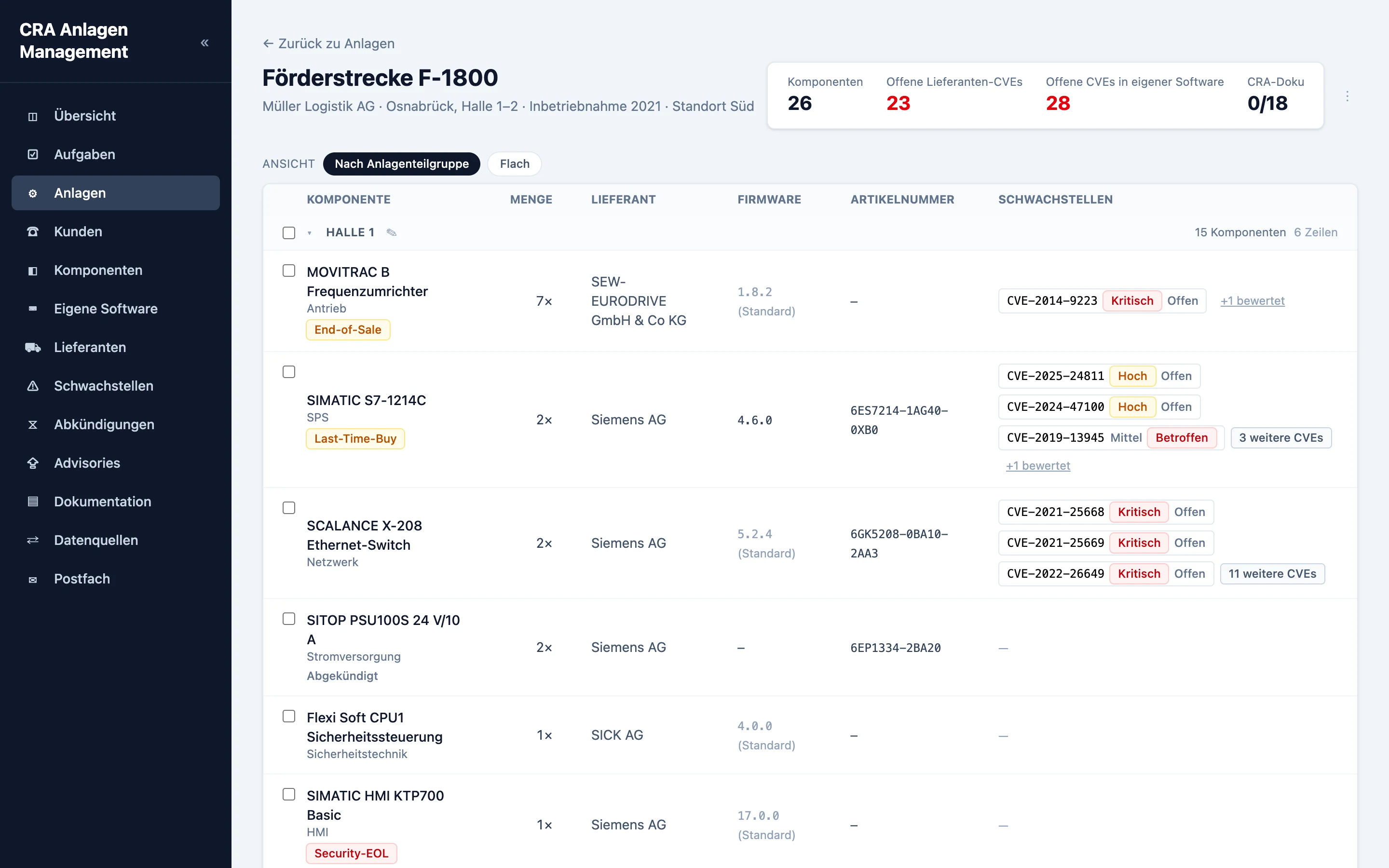

    Werkspilot: installation “Conveyor F-1800” with 26 components, firmware version, order number and open vulnerabilities per device

    From December 2027 a condition for CE: deliver installations without known exploitable vulnerabilities – do you know yours?

    Recording order number and firmware version for every device in an installation is manual work – and due again after every retrofit.

    Matching thousands of supplier advisories a year against thousands of components in hundreds of installations cannot be done by hand.

    Control manufacturers publish advisories by order number, not by CPE – standard SBOM tools such as Dependency-Track never find the advisory for an S7-1500.

    Capture the installation, monitor vulnerabilities, assess risks.

    Module 1 · SBOM capture

    Order number and firmware version per device – from network scan, EPLAN parts list or engineering portal.

    The scan from the maintenance PC reads manufacturer, order number and firmware straight from the devices – PROFINET, SNMP, EtherNet/IP, Modbus, OPC UA. Engineering portal and EPLAN fill in the rest.
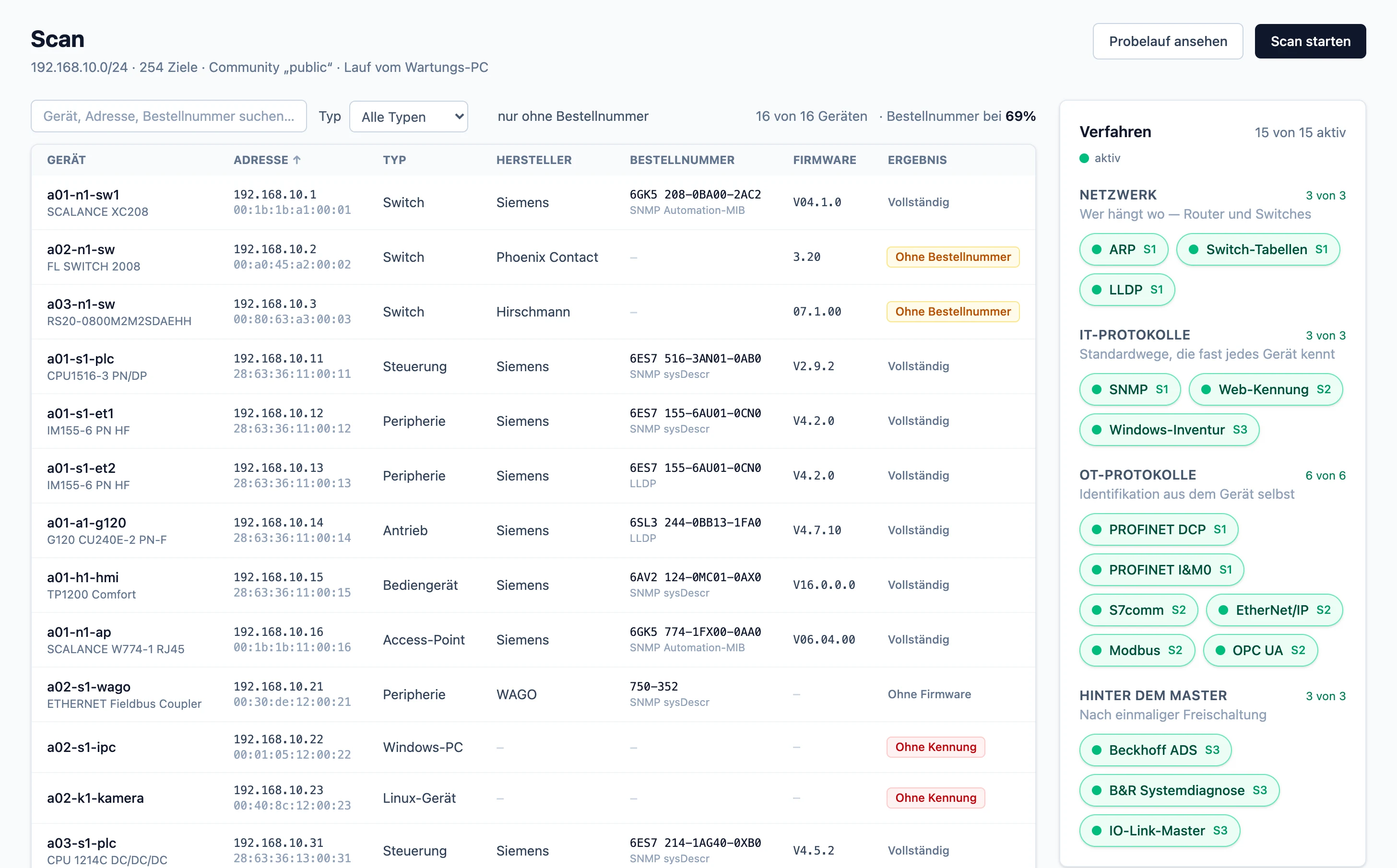
    Werkspilot Scan: 16 devices of one installation with manufacturer, order number, firmware and result, next to the active scan methods from ARP to OPC UA

    Module 2 · Vulnerability monitoring

    See within seconds which installation a vulnerability affects – including built-in control components.

    Supplier feeds from CSAF to email and your own firmware monitored continuously, every advisory matched automatically to the installed component. Assessment per installation with AI suggestions, customers and ENISA notified with one click.
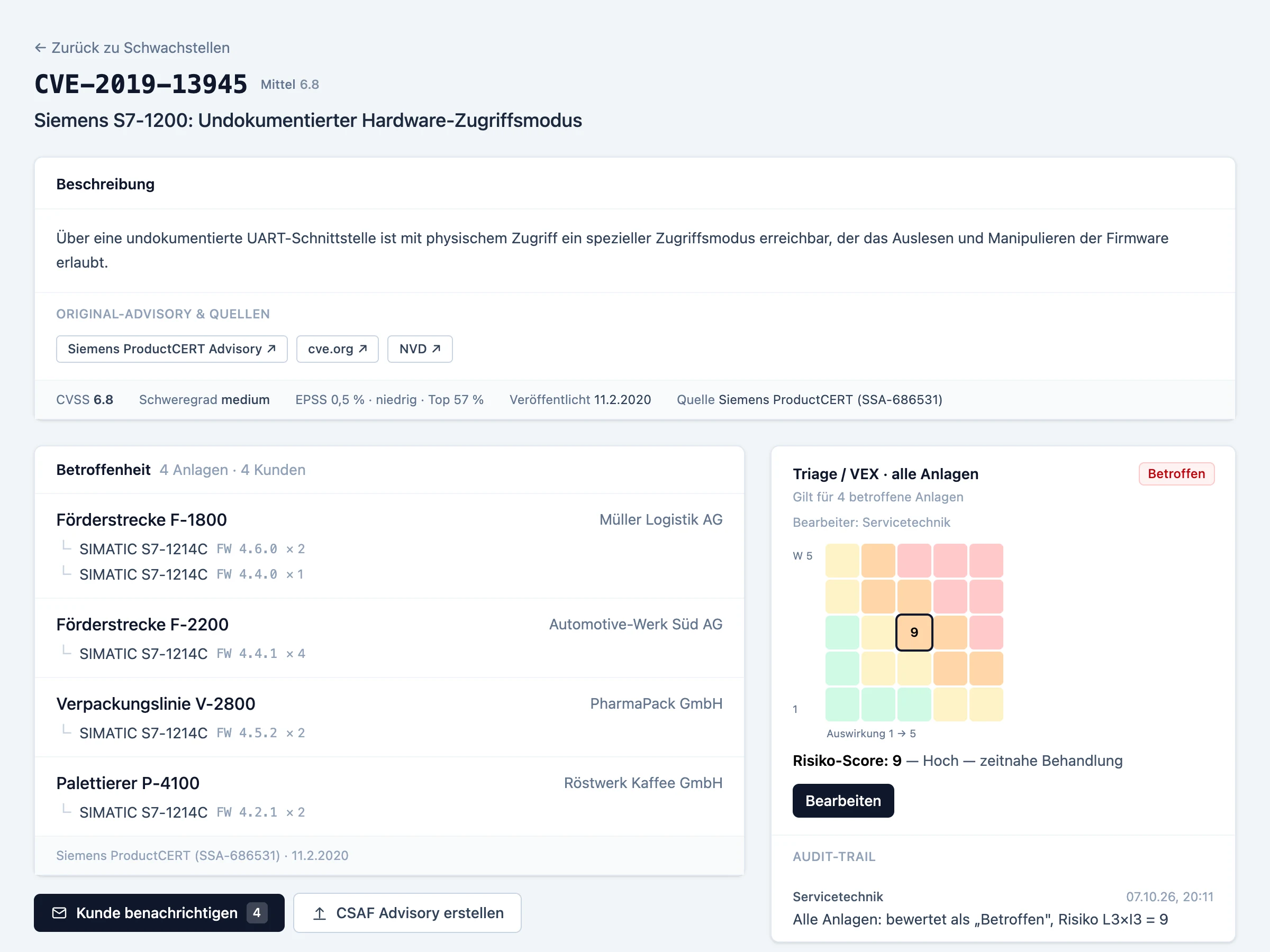
    Vulnerability CVE-2019-13945: affected installations and customers, triage matrix with risk score, buttons “Notify customer” and “Create CSAF advisory”

    Module 3 · Risk assessment

    Build the risk assessment once per installation type, reuse it per project.

    Data flow diagram, STRIDE risks with measures and requirements – from templates, AI-prefilled, auditable for CRA and the Machinery Regulation. New vulnerabilities are assessed against this baseline.
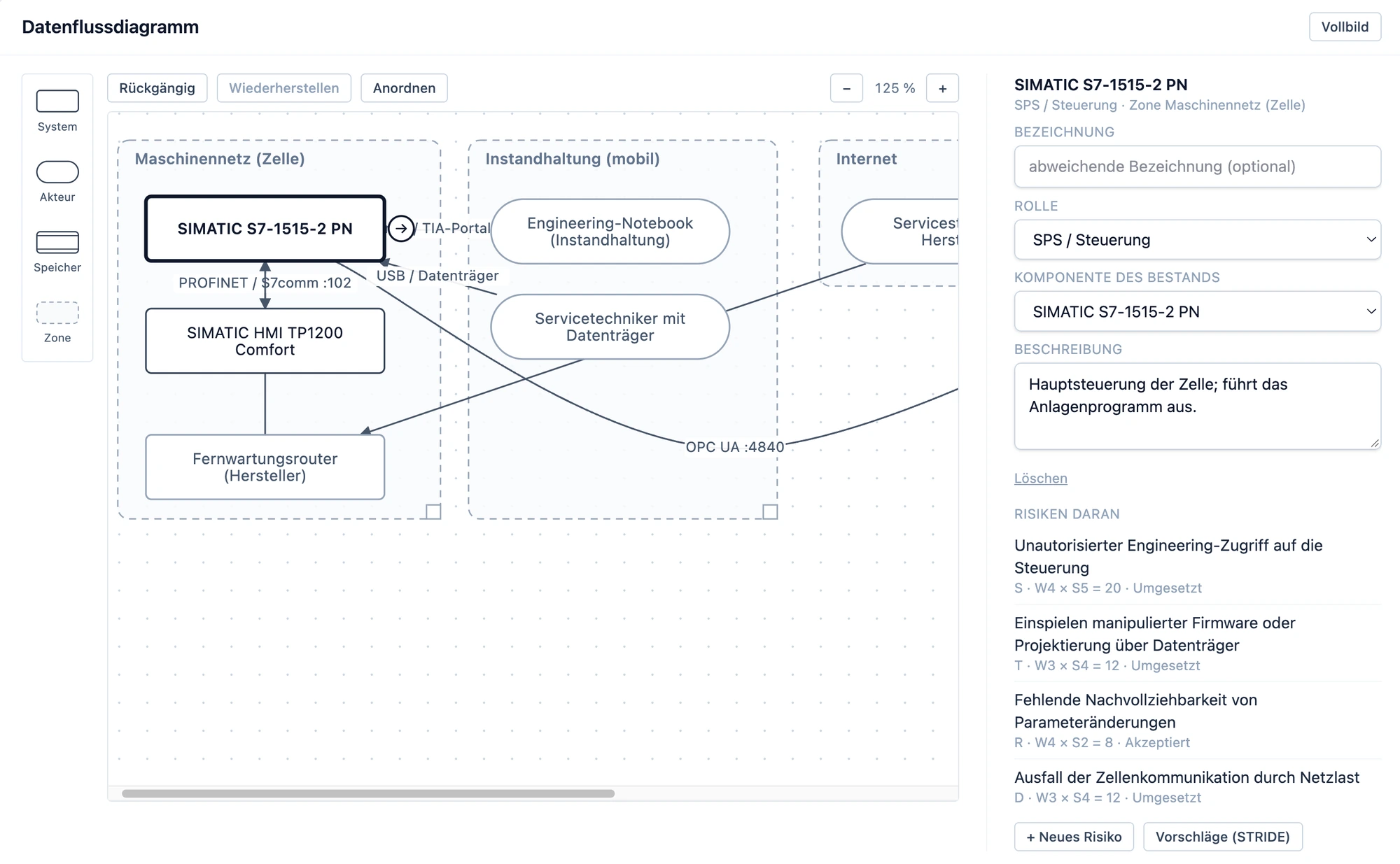
    Risk assessment in Werkspilot: data flow diagram with zones machine network, maintenance and internet; SIMATIC S7-1515-2 controller selected, next to it role, description and the four STRIDE risks attached

    We build the first risk assessment with you.

    Baseline assessment for one installation type in two sessions: system capture with network diagram and interfaces, then a review with your design engineers. After two weeks it is ready to sign and serves in Werkspilot as the template for the following projects.

    “With Werkspilot we have a capable partner who supports us in meeting the requirements of the Cyber Resilience Act – both as advisors and technically, from risk analysis through to implementing systematic vulnerability monitoring.”

    Günter Arztmiller

    Managing Director, The Imaging Source GmbH

    The Imaging Source logo
    Günter Arztmiller, Managing Director of The Imaging Source GmbH

    Guide (PDF)

    The plant SBOM in five steps.

    Compact on 14 pages, with a checklist per step. As of October 2026.

    Request the guidePDF · 14 pages · free · DE/EN

    Frequently asked questions on the CRA, the Machinery Regulation and vulnerability management for machine and plant builders and integrators.

    The CRA applies to products with digital elements placed on the EU market — in machine and plant engineering, that means controllers, networked components and the installation as a whole system with a software share. Any integrator or plant builder who integrates third-party components and places them on the market under their own name is considered a manufacturer under the CRA and carries its obligations.

    The reporting obligations of the Cyber Resilience Act (CRA) have applied since 11 September 2026. Since that date, manufacturers — including machine and plant builders and integrators — must report actively exploited vulnerabilities and severe security incidents to the competent national authority (CSIRT) and to ENISA. The remaining CRA requirements apply in full from 11 December 2027.

    The fixed deadlines apply towards the authorities: via ENISA's single reporting platform, an actively exploited vulnerability or a severe security incident requires an early warning to the coordinating CSIRT and ENISA within 24 hours of becoming aware, a more detailed notification within 72 hours, and a final report later on. Affected users, by contrast, are informed not on an hourly deadline but "without undue delay" about the vulnerability or incident and any countermeasures. For integrators and plant builders with hundreds of components per installation, neither is realistic without automated vulnerability management.

    An SBOM (Software Bill of Materials) is a complete inventory of all software components of a product. The CRA requires manufacturers to know and document their components. For plant builders, the SBOM is the basis for instantly identifying which installations are affected when a vulnerability is reported.

    Werkspilot continuously monitors your suppliers' security advisories — structured CSAF feeds as well as mailing lists, RSS or unstructured emails. Every new vulnerability (CVE) is automatically matched against your installations in the field, so you immediately see which installations are affected. This continuous monitoring produces one central, normalized overview instead of scattered individual alerts.

    CVE monitoring across the supply chain means: new vulnerabilities (CVEs) from your suppliers' security advisories are captured continuously and automatically matched against the components in your installations in the field. Werkspilot normalizes structured CSAF feeds as well as mailing lists, RSS and unstructured emails — because many suppliers don't publish their CVEs as CSAF. So for every new CVE you immediately see which installations are affected, instead of searching manufacturer advisories by hand.

    CSAF (Common Security Advisory Framework) is a machine-readable standard format for security advisories, increasingly used by manufacturers and authorities such as the German BSI and the US CISA. Machine-readable CSAF feeds can be processed automatically — the basis for monitoring supplier vulnerabilities without manual research and immediately mapping them to affected installations.

    Manufacturers must handle vulnerabilities and provide security updates throughout the support period — at least five years, unless the product's expected lifetime is shorter. For long-lived industrial installations this period can be correspondingly longer.

    For violations of the essential cybersecurity requirements, the CRA provides for fines of up to €15 million or 2.5% of worldwide annual turnover — whichever is higher. That alone is reason for integrators and plant builders to establish vulnerability and reporting processes early.

    The EU Machinery Regulation (EU) 2023/1230 applies from 20 January 2027 and contains its own cybersecurity requirements. The CRA and the Machinery Regulation interlock: meeting the CRA requirements for vulnerability handling, SBOM and security by design covers essential cybersecurity duties of the Machinery Regulation. The IEC 62443 standard series serves as technical guidance.

    STRIDE is a structured threat-modelling method (Spoofing, Tampering, Repudiation, Information Disclosure, Denial of Service, Elevation of Privilege). For the risk assessment of an installation under the Machinery Regulation and CRA, a STRIDE analysis systematically identifies attack points at the interfaces and derives protective measures. We produce STRIDE risk assessments for installations as the basis for auditable security documentation.

    Werkspilot captures all supplier advisories — from CSAF to email — centrally, automatically identifies the affected installations and lets you forward an assessed report to your customers on time. This way you fulfil the CRA reporting chain across hundreds of components and installations without manually checking every feed.

    Request a demo now.

    See how you can manage vulnerabilities for your installations simply and meet every reporting deadline.